In today’s business environment, keeping up with technology is not enough. Companies must go further; they need to embed technology into the very core of how they operate. That is the idea behind digital infusing Aggr8Tech: a framework where advanced digital tools are not bolted onto existing systems as extras, but woven deeply into every process, decision, and customer interaction.
If you’ve searched for this term and wondered what it actually means in practice, not just theory, this article breaks it down clearly. From how it works and where it’s being applied, to the challenges no one warns you about, you’ll find everything here that other articles leave out.
What Does Digital Infusing Aggr8Tech Actually Mean?
Digital infusing means making technology inseparable from operations. It is not about deploying a new app or switching platforms. It is about restructuring how a business thinks, communicates, and executes with digital intelligence built into every layer.
Aggr8Tech addresses the aggregation side of this equation. Instead of running ten disconnected tools that don’t talk to each other, Aggr8Tech is the philosophy and increasingly the platform where you build one intelligent ecosystem. Every tool, dataset, workflow, and API connects and communicates as a unified whole.
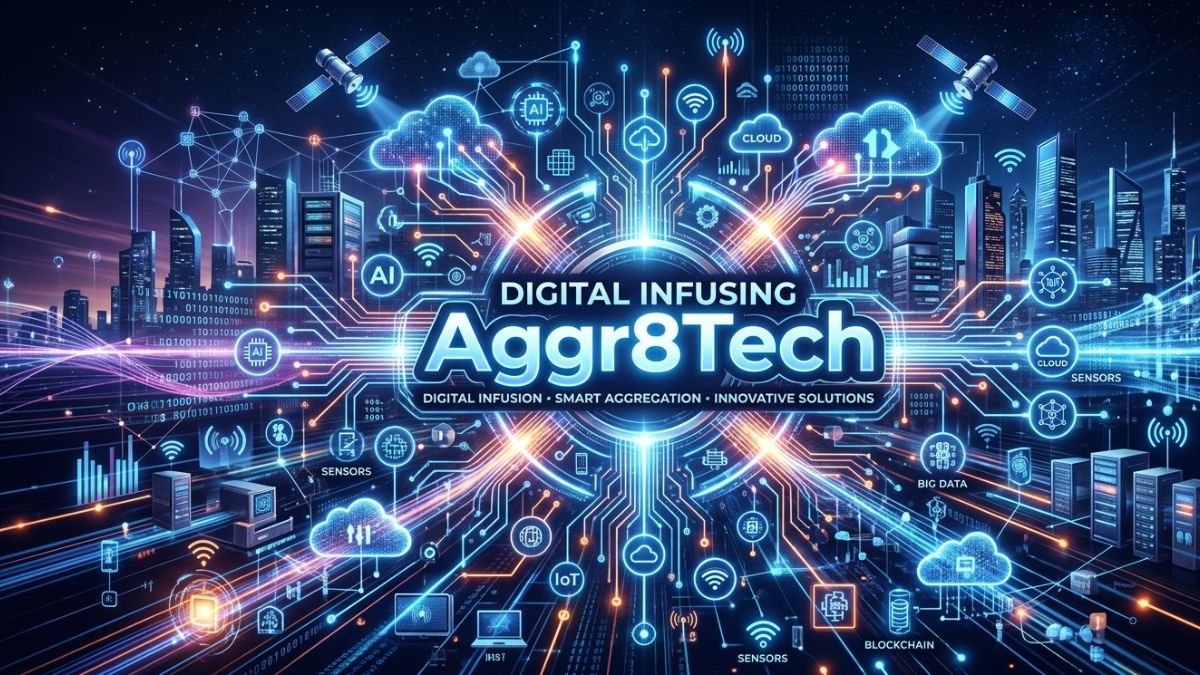
Put both concepts together, and you get something genuinely powerful: a business operating model where artificial intelligence, cloud infrastructure, automation, real-time analytics, and IoT sensors are not optional features. They are the structural foundation on which everything else rests.
A simple analogy: think about how a world-class restaurant kitchen operates. Every station knows what the others are doing. No motion is wasted. Timing is precise. The system itself feels alive. That is what digital infusing Aggr8Tech achieves for modern businesses.
Why Businesses Are Adopting This Framework Now
Several forces have converged to make this shift urgent rather than optional.
Customer expectations have shifted permanently. People expect faster responses, personalized experiences, and seamless interactions across every channel. Manual processes and isolated databases cannot deliver this at scale.
Competition has compressed decision timelines. Businesses that act on data weeks after it is collected lose ground to competitors acting on it in real time. Speed of insight has become a competitive advantage.
Data volumes have outgrown human management. Modern operations generate millions of data points daily — from inventory systems, CRM platforms, logistics networks, and customer interactions. Manually connecting these systems is not a bottleneck; it is an impossibility.
The cost of integration failures is rising. Duplicate records, broken pipelines, inconsistent reporting, and compliance exposure all cost real money. According to IBM’s 2025 CDO study, only 26% of chief data officers feel confident their data capabilities can support new AI initiatives. That gap is exactly what Aggr8Tech is designed to close.
Core Technologies That Power Digital Infusing Aggr8Tech
The term “digital infusing” can feel abstract. Here is what it actually looks like in practice, the specific technologies that make this framework real:
| Technology | Role in the Ecosystem |
|---|---|
| Artificial Intelligence (AI) | Automates decisions, detects patterns, personalizes user experiences |
| Cloud Computing | Provides scalable, accessible infrastructure without hardware limits |
| IoT Sensors | Collects real-world data (temperature, location, usage, behavior) continuously |
| Real-Time Analytics | Turns raw data into actionable insights in seconds, not days |
| Automation Tools | Removes manual steps from repetitive, rules-based workflows |
| Pre-Built Connectors | Links existing software platforms without custom development work |
| Natural Language Processing (NLP) | Powers intelligent chatbots, voice interfaces, and document parsing |
None of these technologies is revolutionary in isolation. Their power comes from integration, each one feeding and learning from the others in a continuous loop.
How Implementation Actually Works (The Part Most Articles Skip)
Most content about digital infusing Aggr8Tech describes the destination without explaining the journey. Here is an honest look at what real implementation involves.
Step 1: Start With the Business Problem, Not the Technology
Organizations that rush into platform selection before identifying the problem they’re solving almost always hit costly detours. The right starting point is a clear-eyed audit: where are decisions slow? Where does data get lost between systems? Where are customers frustrated by inconsistent experiences?
Step 2: Map Your Existing Data Landscape
Before connecting anything, you need to know what exists. This means cataloguing every system, database, API, and manual process currently in use, including the informal spreadsheets that nobody talks about but everyone depends on.
Step 3: Build Connectors Strategically
Modern Aggr8Tech platforms offer large libraries of pre-built connectors for popular software. The trap many organizations fall into is connecting everything at once. A better approach is prioritizing the highest-friction integration points first, the places where data is currently moving manually between systems.
Step 4: Transform Data in Transit, Not Just at Rest
One of the least-discussed capabilities of this framework is in-transit transformation. You are not just moving data from point A to point B. You are cleaning it, enriching it, reformatting it, and routing it to the right destination, all while it moves. This is critical for maintaining data quality across complex ecosystems.
Step 5: Invest in Documentation Before You Need It
This is where many implementations stumble. Platforms evolve. Webhook structures change. Authentication protocols update. Organizations that do not maintain current internal documentation end up with developers spending days debugging issues that should take hours — often because the platform’s own official docs lag behind product updates.
Where Digital Infusing Aggr8Tech Is Delivering Real Results
E-Commerce and Retail
Retailers using fully integrated digital ecosystems can respond to inventory changes, demand spikes, and customer behavior shifts in near real-time. When a product sells out on the website, the system updates the warehouse, notifies suppliers, adjusts ad spend, and surfaces alternatives to customers automatically, without human intervention.
Healthcare and Patient Care
Healthcare providers are using integrated digital systems to connect patient records, lab results, appointment scheduling, billing, and communication in a single flow. The result: faster diagnoses, fewer administrative errors, and better patient experiences.
Agriculture and Food Production
An often-overlooked application is precision agriculture. IoT sensors monitor soil moisture, temperature, and crop health. AI analyzes patterns and recommends interventions. Automated irrigation and nutrient delivery systems respond to those recommendations. The entire growing cycle becomes data-driven rather than intuition-driven, which is especially valuable as climate variability increases.
Financial Services
Banks and fintech companies use integrated real-time analytics to detect fraud, personalize product recommendations, automate compliance checks, and manage risk exposure. The speed advantage alone, detecting an unusual transaction in milliseconds rather than flagging it in a batch report the next morning, is significant.
The Hidden Challenges Nobody Warns You About
Any honest assessment of digital infusing Aggr8Tech must include the friction points. Here are the ones that consistently catch organizations off guard:
- Month-one developer frustration is almost universal. Complex platforms have steep learning curves. Expect your technical team to struggle with documentation gaps, UI quirks, and undocumented behaviors during the initial setup phase.
- Outdated documentation is a systemic risk. Platform updates often outpace official documentation. Critical areas like OAuth token refresh flows, webhook structures, and authorization parameters frequently contain outdated instructions that cause silent failures.
- “Zero-friction setup” is a sales myth. No serious data integration platform sets itself up. Organizations that go in expecting a plug-and-play experience consistently underestimate the upfront investment required to build a solid data foundation.
- Security complexity scales with connectivity. Every new integration point is a potential attack surface. As systems become more interconnected, security architecture must evolve in parallel, not as an afterthought.
- Change management is underestimated. Technology is often the easier part. Getting teams to trust automated decisions, adopt new workflows, and abandon familiar manual processes requires sustained organizational effort.
Digital Infusing Aggr8Tech vs. Traditional Digital Transformation
| Dimension | Traditional Digitization | Digital Infusing Aggr8Tech |
|---|---|---|
| Approach | Add digital tools to existing processes | Rebuild processes around digital intelligence |
| Data | Stored in siloed systems | Flows continuously between connected systems |
| Decision-making | Humans review reports and decide | Systems surface recommendations; humans set parameters |
| Scalability | Increases with headcount | Increases with data volume and model quality |
| Integration | Manual or bolt-on connectors | Native, real-time, bidirectional |
| Outcome | Incremental efficiency gains | Structural operational transformation |
Frequently Asked Questions
What is digital infusing Aggr8Tech in simple terms?
It is the process of embedding advanced technologies, AI, automation, cloud systems, and analytics so deeply into business operations that they become inseparable from how the organization functions, rather than just tools sitting on top of it.
Is Aggr8Tech a specific product or platform?
The term refers to both a conceptual framework and, in some contexts, specific data integration platforms that apply this aggregated, connected approach to enterprise technology stacks.
How long does implementation typically take?
Depending on the organization’s size and existing infrastructure, initial integration work typically takes three to six months before meaningful operational results appear. Full maturity can take twelve to eighteen months.
Is this framework only for large enterprises?
No. While large organizations often have more complex integration needs, the core principles apply at any scale. Small and mid-sized businesses benefit significantly from connecting their key operational tools, CRM, inventory, finance, and marketing, into a unified data flow.
What is the biggest risk of not adopting this approach?
Organizations that continue operating with siloed, disconnected systems face compounding inefficiencies, slower decision-making, and reduced ability to serve customers at the pace competitors can. The gap between integrated and non-integrated operators is widening, not narrowing.
How does this relate to AI adoption?
Without clean, connected, real-time data, AI systems cannot perform reliably. Digital infusing Aggr8Tech creates the data foundation that makes meaningful AI implementation possible, which is why it has become a prerequisite for most enterprise AI strategies.
The Bottom Line
Digital infusing Aggr8Tech is not a trend to watch from the sidelines. It is the structural shift that separates organizations capable of competing at modern pace from those stuck in the efficiency ceiling of disconnected systems.
The framework delivers real results — faster operations, better customer experiences, smarter decisions, but it demands real commitment. The organizations that benefit most go in with clear problem statements, realistic timelines, and a genuine willingness to invest in the foundation before expecting the returns.
Start with one high-friction integration point. Solve it completely. Then build from there. That is how robust, durable digital ecosystems are actually built, one connected layer at a time.